







Have you ever had a round where nothing felt wrong… but nothing felt quite right either?
Your swing wasn’t terrible. Your tempo was fine. But something was just slightly off. You couldn’t settle into it. You kept adjusting—your sleeve, your collar, the way the fabric sat on your shoulders. Small things. Easy to dismiss.
And yet, they stayed with you the entire round.
Most people blame their game when that happens. Or their mindset. Or just “one of those days.”
But more often than you’d expect, it comes down to something much quieter. Your Golf Apparel Materials.
Not in an obvious way. Not in a dramatic, “this is uncomfortable” kind of way. It’s subtler than that. It builds slowly. A little too warm. A little too stiff. A little too present. Until your clothing becomes something you’re aware of—and that awareness is enough to pull you out of your rhythm.
Why Golf Apparel Materials Matter More Than You Realise
Golf is not a high-intensity sport in the traditional sense. But it’s demanding in a different way.
You’re outdoors for hours. The conditions shift. Your body alternates between movement and stillness. You swing, then you wait. You walk, then you stop. You heat up, then cool down. Over and over again.
Your clothing has to adapt to all of that, without asking for attention.
That’s where most apparel falls short.
According to REI, moisture-wicking fabrics work by pulling sweat away from the skin so it can evaporate more efficiently, helping maintain comfort during activity.
But the real impact isn’t just physical comfort. It’s cognitive. The moment your clothing starts feeling damp or heavy, you become aware of it. And once your attention shifts there—even slightly—it competes with your focus.
It sounds minor. It isn’t.

Image from Sunday Golf
Then there’s sun exposure. According to the Skin Cancer Foundation, UPF-rated fabrics can block up to 98% of UV radiation depending on the rating.
What people don’t usually consider is how that protection changes over time. When fabric stretches, or when it becomes saturated with sweat, its effectiveness can drop. So the same piece of clothing doesn’t behave consistently across an entire round.
That inconsistency—that’s where discomfort starts creeping in.
So when we talk about Golf Apparel Materials, we’re not talking about preferences. We’re talking about stability. Consistency. The ability to feel the same on the 15th hole as you did on the first.
The Subtle Mistake Most People Keep Making
There’s a common assumption that natural fabrics are inherently better.
Cotton feels breathable. Linen sounds ideal. Wool feels premium.
It makes sense—until you actually spend four hours in them.
According to REI, many synthetic fabrics like polyester are used in performance apparel because they resist absorbing moisture, allowing sweat to move outward and evaporate more quickly.
Cotton does the opposite. It absorbs. It holds. It lingers.
So what feels soft and airy at the start can feel noticeably heavier, slightly damp, and a bit clingy halfway through your round.
Not uncomfortable enough to complain about. Just uncomfortable enough to notice.
And noticing is the problem.
There’s also confusion around materials like nylon and polyamide. According to Britannica, nylon is simply a type of polyamide—it’s not a separate category.
So the real distinction isn’t natural vs synthetic.
It’s whether the fabric is designed for movement, heat, and recovery—or whether it’s just… fabric.
The Fabric Issues That Don’t Seem Like a Big Deal (Until They Are)
Most poor material choices don’t fail loudly. They fail gradually.

Image from Fairmonde Golf Facebook
When Cotton Stops Feeling Comfortable
Cotton is familiar. It feels safe. Which is why people keep reaching for it.
But on the course—especially in humidity—it behaves differently.
According to Cleveland Clinic, cotton absorbs moisture and dries slowly, which can lead to chafing and discomfort during activity.
So by the time you’re a few holes in, the fabric isn’t what it was when you put it on. It sits heavier. It sticks a little more. It doesn’t move as freely.
And here’s the part people don’t say out loud:
Once your clothing starts to feel off, you start playing slightly differently.
You adjust. You compensate. You lose a bit of ease.
When Fabric Pushes Back Against Your Swing
This one is easy to miss.
Your clothing isn’t tight. It fits well. But something feels slightly restrictive when you rotate.
That’s usually a lack of stretch.
According to MasterClass, elastane (or spandex) allows fabrics to stretch and return to their original shape, which is why it’s commonly used in performance wear.
Without that elasticity, fabric doesn’t follow movement—it resists it.
And resistance, even subtle resistance, changes how freely you swing.
You might not notice it consciously. But your body does.
When “Protection” Starts Working Against You
A lot of golfers default to heavier outerwear for protection.
Waterproof. Windproof. Layered.
But if that layer isn’t breathable, it traps heat and moisture.
According to REI, when water-repellent coatings degrade, outerwear can become saturated and feel clammy, even if it’s technically still waterproof.
So instead of shielding you, it creates a warm, damp environment around your body.
It’s the kind of discomfort that builds slowly—and once it does, it’s hard to shake.
When Sun Protection Isn’t Considered Properly
Most people think sunscreen is enough.
But clothing matters just as much.
According to the Skin Cancer Foundation, fabrics with tighter weaves and higher UPF ratings provide better protection against UV exposure.
The nuance is that protection changes with movement. When fabric stretches across the shoulders or chest, coverage decreases.
So a piece that feels light and flexible also needs to maintain structure—otherwise, it’s not doing what you think it is.
What Good Golf Apparel Materials Actually Feel Like

Image from Fairmonde Golf
The best materials don’t feel impressive.
They feel absent.
You’re not adjusting them. You’re not thinking about them. They don’t shift, cling, or resist. They just sit where they should and move when you do.
That’s usually the result of thoughtful blends.
Polyester combined with elastane, for example, gives you breathability, flexibility, and faster drying. It’s one of the most reliable combinations for warm, humid conditions.
Fairmonde’s Revive Pro Polo uses a recycled polyester-elastane blend designed for four-way stretch, moisture-wicking, and UPF protection—not as abstract features, but as things that actually show up halfway through your round.
Polyamide blends—often misunderstood—are another strong option. They’re lightweight, smooth, and durable, which makes them ideal for fitted silhouettes.
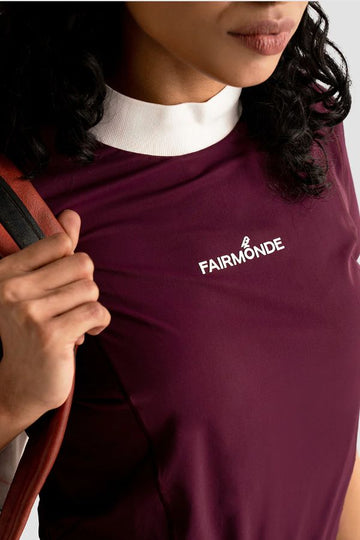
The Tamarillo Mock Neck Tee, for instance, uses a polyamide-LYCRA blend that feels structured but still moves easily with the body.
And then there’s merino wool.
According to MasterClass, merino wool is softer than traditional wool, breathable, and naturally moisture-wicking, with the added benefit of temperature regulation.
It’s not always the first choice for high heat—but for layering, travel, or cooler mornings, it works in a way most people don’t expect.
How to Choose the Right Golf Apparel Materials (Without Overthinking It)

Image from Polina Tankilevitch on Pexels
You don’t need to understand textile engineering.
You just need to pay attention to how something behaves.
Does it stretch easily when you move?
Does it feel light—or slightly heavy?
Does it dry quickly—or hold onto moisture?
Does it stay consistent after 20–30 minutes of wear?
Then look for indicators like:
-
Moisture-wicking
-
Breathability
-
Four-way stretch
-
Quick-dry
-
UPF rating
These aren’t just features. They’re signals of how the garment performs over time.
And here’s something simple but useful:
If something feels slightly off when you first try it on, it won’t feel better later.
According to Cleveland Clinic, factors like moisture, seams, and fabric texture contribute to discomfort and chafing during activity.
Clothing doesn’t improve mid-round. It reveals itself.
Dressing for the Conditions You Actually Play In
Regular inspection of your golf apparel for signs of wear and tear can help you address
For hot, humid conditions, go lighter. Breathable, quick-drying, with enough stretch to move freely.
For unpredictable weather, layer lightly. Avoid relying on one heavy piece.
For cooler mornings, choose materials that regulate temperature rather than trap heat.
The goal isn’t to optimise for one moment. It’s to stay consistent across the entire round.
Caring for Your Golf Apparel Materials

Image from Manteco
Even the best fabrics lose their performance if they’re handled incorrectly.
According to REI, fabric softeners can leave a residue that interferes with moisture-wicking properties.
So if your clothing starts feeling heavier or less breathable over time, it might not be the fabric itself—it might be how it’s being washed.
Keep it simple:
-
Cold wash
-
Avoid fabric softeners
-
Air dry when possible
It’s a small thing. But it keeps the fabric behaving the way it was designed to.
Golf Apparel Questions You Might Still Be Thinking About
1. What fabric is actually best for golf in hot and humid weather?
Lightweight performance blends—typically polyester or polyamide with a bit of elastane—tend to work best. They dry faster, feel lighter on the skin, and don’t hold onto sweat the way cotton does, which makes a noticeable difference after a few holes.
2. Why does my golf outfit feel fine at first but uncomfortable later on?
It usually comes down to how the fabric reacts to heat and moisture. Some materials absorb sweat and become heavier or clingier over time, while others lose breathability. What feels good in the first 10 minutes isn’t always what holds up over 4 hours.
3. How can I tell if a golf outfit will actually perform well before buying it?
Pay attention to how it feels when you move—twist, stretch, and simulate a swing. If it feels slightly restrictive or warm even before playing, it will likely feel worse on the course. Look for stretch, lightness, and breathability over just appearance.
The Difference You Actually Feel
At the start, we talked about that subtle feeling—when something’s just… off, even if you can’t quite explain it.
Here’s the part most people don’t say out loud: a lot of golfers are playing in outfits that look great, but quietly work against them.
Too stiff. Too warm. Slightly restrictive in ways you only notice once you’re a few holes in.
So you adjust. Tug here, shift there. You make it work instead of questioning it.
The right Golf Apparel Materials don’t magically fix your game. But they remove that background friction—the kind you didn’t even realise was there.
You move freely. You stay comfortable. Everything feels consistent from the first tee to the last.
And then, almost without noticing, you stop thinking about what you’re wearing.
You just play.
And honestly, that small shift? It’s often the difference between a round that feels slightly off… and one that finally clicks.